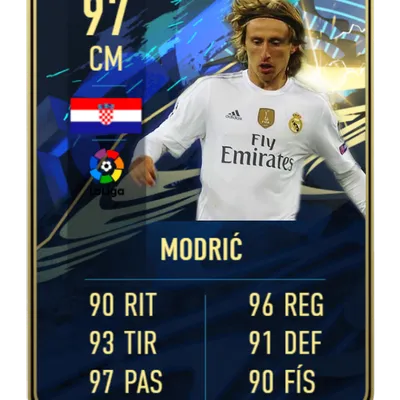
Luka Modrić — Croatia World Cup 2026 Squad
Midfielder Croatia UEFA
 Club: Real Madrid
Career Highlights
Luka Modric will arrive at the 2026 World Cup as the only player in the tournament appearing in his fifth edition, a feat last achieved by essentially no one in the modern era of rotating squads and physical demands. His individual list of honors is disproportionate to the typical profile of a central midfielder: the 2018 Ballon d'Or, three consecutive UEFA Midfielder of the Season awards, six Champions League titles, and a World Cup Golden Ball from the 2018 tournament in Russia. At 40 years old, his 196 caps for Croatia are a national record by a distance, and his 22 international goals understate his actual influence, which has always been measured in rhythm and control rather than final product. Modric remains the single irreplaceable component of a Croatia side that has reached a World Cup final, a World Cup semi-final, and a Nations League final in the last three major tournaments.
Club Career
Modric's club career is defined by his tenure at Real Madrid, which began in 2012 and has produced the most decorated spell by a midfielder in the club's history. He has won six Champions League titles — in 2014, 2016, 2017, 2018, 2022, and 2024 — and four La Liga championships. His partnership with Toni Kroos and Casemiro formed the midfield engine that drove Madrid through the most dominant European run of the modern era. Before Madrid, Modric spent four seasons at Tottenham, where he developed from a creative number ten into a deep-lying organizer. The transformation was not immediate — his first season in Spain was marked by adaptation difficulties — but by 2014 he had become the player Madrid could not function without. His current role has narrowed, with fewer starts and more impact from the bench, but whenever he takes the field the difference in how Madrid construct possession is visible within minutes.
International Career & World Cup History
Modric's international career is the story of a small nation punching far above its weight, with him as the mechanism behind every overperformance. At the 2018 World Cup in Russia, Croatia reached the final for the first time, beating Nigeria, Argentina, Denmark on penalties, Russia on penalties, and England in extra time before falling to France. Modric was named the tournament's best player. At the 2022 World Cup in Qatar, Croatia reached the semi-final again — beating Japan on penalties, Brazil on penalties, before losing to Argentina — and finished third after defeating Morocco. Modric played every meaningful minute in both tournaments. In between, Croatia reached the Nations League final in 2023. The pattern is consistent: Croatia play beyond their talent level because Modric governs tempo, finds solutions under pressure, and refuses to let the team sink into disorder when matches turn difficult.
World Cup 2026 Outlook
Croatia's central problem for 2026 is the one they have been deferring for years: what happens after Modric. No successor has been identified. Mateo Kovacic and Marcelo Brozovic are accomplished players, but neither controls a match the way Modric does. Lovro Majer has shown flashes but has not established himself at the highest level consistently. The entire system that coach Zlatko Dalic has built — patient in possession, disciplined out of it, comfortable in extra time and penalty shootouts — relies on Modric as the reference point. At 40, Modric will not play 90 minutes in every match, and Dalic will need to manage his minutes across the group stage to preserve him for the knockout rounds. The paradox is that Croatia's best chance of a deep run depends on a player whose physical capacity is declining, and no tactical adjustment has yet found a way around that dependency. Modric has earned the right to decide when he leaves, and Croatia will keep selecting him until he does. If this is his final World Cup, it will end the way it began: with Croatia as underdogs and Modric as the sole reason anyone takes them seriously.
Teammates
 DEF
DEF  MID
MID  GK
GK 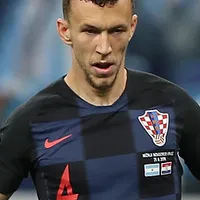 FWD
FWD